


DIESEL FUEL
MAINTENANCE SYSTEMS
(FUEL POLISHING)
WHAT HAPPENS IF YOUR
FACILITY LOSES POWER FOR ONE HOUR?
If you can answer that question with measurable commercial losses and life-critical risks — and if those consequences frighten you — then your operation simply cannot afford downtime.
REDEFINE YOUR MAINTENANCE APPROACH
( FUEL POLISHING )
What would happen if your facility lost power for one hour?
For critical operations, the answer is often measured in financial loss, operational disruption, and life-safety risk. In many facilities, even one minute — or one second — without power is unacceptable. That is why emergency power systems must be treated as critical infrastructure, not simply as backup equipment. Generators, fuel tanks, transfer systems, controls, and the fuel itself must all be ready to operate immediately when required. While redundancy, preventive maintenance, regular testing, and emergency preparedness are essential, long-term fuel quality is equally critical to true operational reliability.
Diesel fuel naturally degrades over time. Water, particles, microbial growth, oxidation, and sludge formation can compromise fuel quality and create serious risks for generators and fuel systems. EVERGEE fuel maintenance systems are designed to go beyond physical cleaning alone. In addition to removing water and solid contamination, they support fuel preservation through controlled bio-chemical dosing, helping to manage the key causes of diesel degradation together. This integrated approach makes EVERGEE a preferred solution for mission-critical facilities that require cleaner, drier, and more reliable fuel over time.
Because Diesel Degrades. And critical power cannot fail.
EVERGEE'S SOLUTION
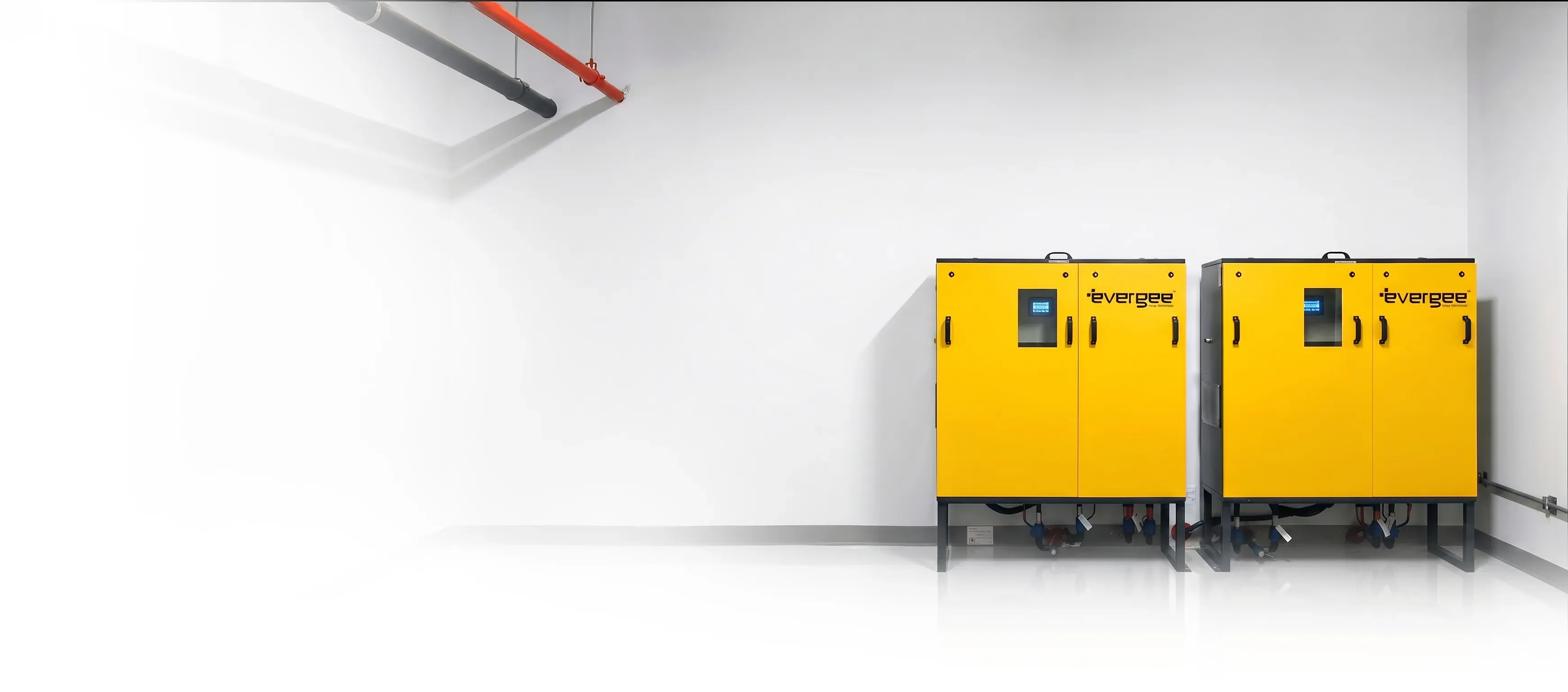
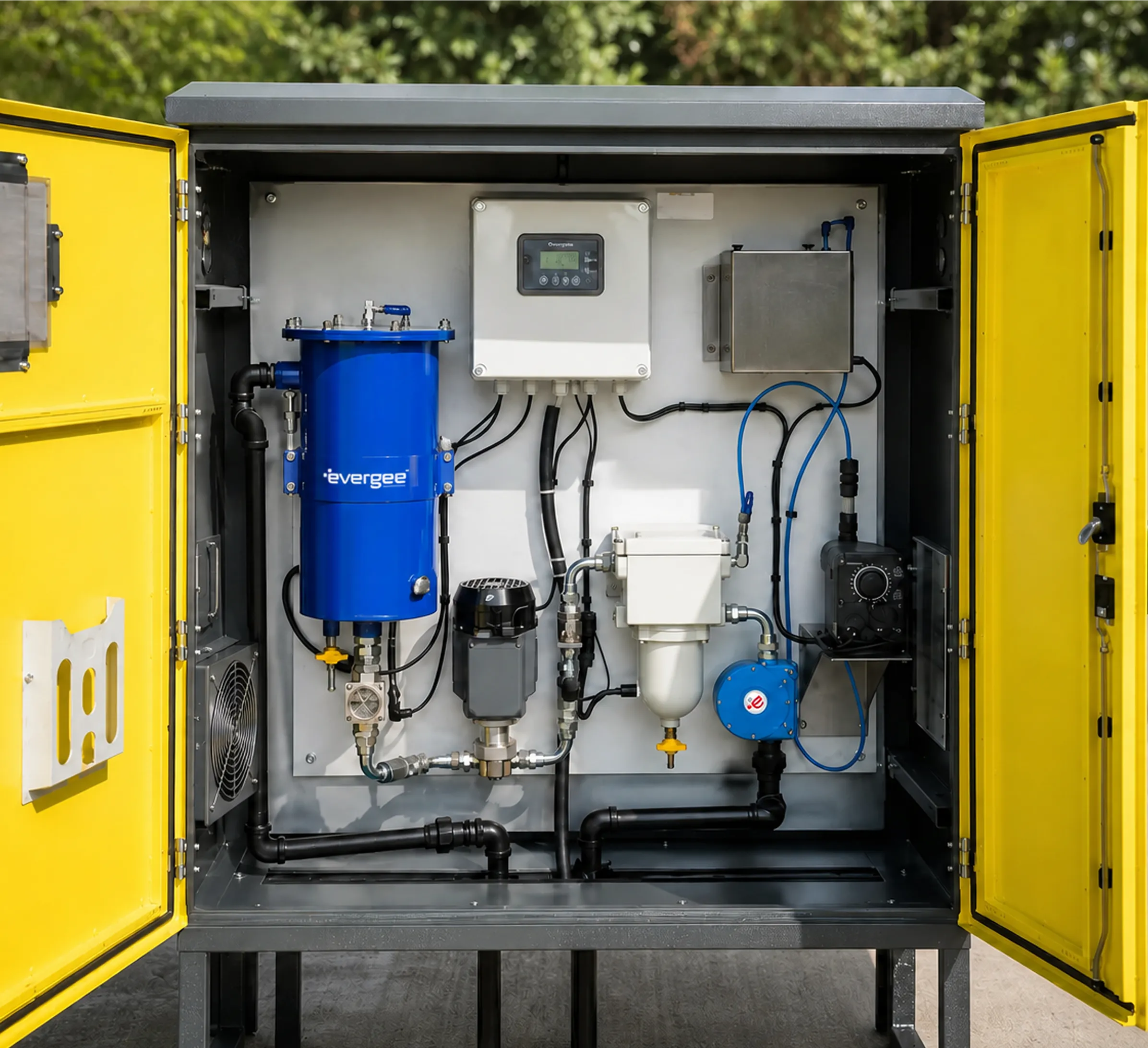
FMPS (Fuel Maintenance & Polishing System) is an integrated engineering system that actively monitors, cleans, and preserves stored diesel fuel around the clock. It combines multi-stage filtration, high-efficiency water separation, microbiological control, and controlled chemical dosing in a single automated platform. By removing solid contamination and water while helping to control microbial activity, oxidation, sludge formation, and long-term fuel degradation, FMPS continuously maintains stored diesel fuel at required quality standards and supports the reliability of critical emergency power systems.
REQUEST TECHNICAL DOCUMENT
DIESEL FUEL MAINTENANCE SYSTEM FEATURES
Continuous Filtration
24/7 multi-stage filtration continuously removes particulate contamination and sediment. ISO 4406-compliant fuel quality guaranteed.
Water Separation
High-efficiency coalescers and water detectors continuously separate and drain both free and emulsified water from fuel.
Microbiological Control
Detects bacterial and fungal colonies that degrade fuel quality, and neutralizes them through biocide dosing.
Controlled Chemical Dosing
Protects more than the physical cleanliness of stored diesel fuel. Through controlled dosing of stabilizers, biocides, detergents, anti-foam agents, demulsifiers, injector cleaners, and combustion catalysts, FMPS supports fuel stability, cleaner combustion, and a 360-degree fuel maintenance approach.
Multi-Tank Solutions
Maintains consistent fuel quality across single or multiple storage tanks through centralized circulation, monitoring, and automated maintenance. Ideal for large-scale and mission-critical facilities where every tank must remain clean, dry, stable, and ready for operation.
Custom Design
Engineered around your site conditions, tank layout, fuel capacity, redundancy requirements, automation level, and BMS/SCADA integration needs. FMPS delivers a tailor-made fuel maintenance solution that fits your operation — not the other way around.
Automated Monitoring
Integrated sensors and a PLC control panel monitor fuel quality parameters in real time, log data, and generate alarms.
Remote Access
Monitor, manage, and intervene from anywhere in the world via SCADA/BMS integration and a web-based interface.
Reporting
ISO 4406-compliant automated reports — including periodic fuel analysis results, maintenance history, and compliance documentation — are recorded digitally.
First, refinery manufacturing specifications changed due to environmental concerns about diesel fuel. As defined by the limits set in TS-EN590, the sulfur content in fuel was progressively reduced. The new ultra-low-sulfur diesel is more environmentally friendly, but it has lost one of its most important lubricating agents — shortening the storage life of diesel in tanks.
Biodiesel blending, which had been on the agenda in the EU and US for some time, became mandatory in Turkey as of January 1, 2018. All distributors are required to blend a minimum of 0.5% biodiesel, with a maximum of 5% — and 2% is supported by an excise tax exemption. While biodiesel, produced from vegetable or waste oils, delivers significant economic benefits as a high-calorific additive, it requires special care to maintain fuel stability in medium- to long-term storage.
Engines and injection systems have changed. In pursuit of better fuel economy, improved combustion, and higher output, R&D advances have brought us TIER IV and TIER V engines. These engines feature far more sensitive injection systems and fuel lines operating under significantly higher pressures and temperatures than those of a decade ago. It is clear that conventional preventive maintenance practices will be insufficient in infrastructure operating these engines.
The requirements of today's business world have changed. Continuity is now more critical than ever before. And downtime is now more costly than ever before. As a result, businesses are paying much closer attention to the sizing, redundancy, regular testing, and periodic maintenance of emergency power systems.
Diesel is a fossil-based fuel — one of many by-products of crude oil distillation — and is a multi-carbon-bonded hydrocarbon chain. Updated manufacturing specifications driven by environmental concerns, along with mandated low sulfur ratios and biodiesel blending requirements, have created a situation that demands careful attention in medium- to long-term storage.
As a fossil-based fuel, diesel naturally contains various aerobic and anaerobic bacterial and fungal spores. In environments where water is present, these bacteria and fungi multiply logarithmically and, if left uncontrolled, can infect the entire fuel supply.
Throughout its entire journey from the refinery to the end user's tank, diesel accumulates various physical contaminants — solid particles, dust, metallic debris, and other unwanted agents settle in the tank as a result of transport.
The most critical property of fuel is its calorific composition and combustibility. If fuel that is free of all other contaminants is not in the correct chemical composition, it is non-functional — and will cause the infrastructure designed to run on diesel to fail when needed.
CRITICAL POINTS IN DIESEL FUEL MAINTENANCE
The systems that keep critical facilities running tolerate no compromise. Neither should the fuel maintenance systems that support them.
WHERE SHOULD MAINTENANCE START?
Redefine Your Maintenance Approach
Generator maintenance in critical facilities is usually performed with great care. Yet one of the most critical elements is often overlooked: the diesel fuel stored in the tank. When fuel is left unmanaged, it degrades physically, chemically, and microbiologically. This can lead to clogged filters, injector problems, generator failure, costly repairs, and unplanned downtime. True generator reliability starts with clean, dry, stable, and continuously maintained fuel.
LINE FILTERS OR 360° EVERGEE CARE?
Redefine Stored Fuel Reliability
Line filters are designed to protect equipment during fuel transfer. They are not designed to preserve the quality of diesel fuel sitting in storage tanks for months or years. EVERGEE FMPS delivers 360° fuel care by continuously treating stored diesel fuel through water separation, fine filtration, microbial control, oxidation management, sludge prevention, controlled chemical dosing, and real-time monitoring. The result is cleaner, drier, more stable fuel — ready when critical power is needed.
WHY DO LEADING FACILITIES WORK WITH US?
Because Critical Fuel Requires Continuous Protection
EVERGEE supports mission-critical facilities with engineered fuel maintenance systems designed for long-term reliability. Our systems combine continuous filtration, high-efficiency water separation, microbiological control, controlled chemical dosing, automated monitoring, and BMS/SCADA integration. With field-proven engineering, qualified service support, and solutions designed around real site conditions, EVERGEE helps keep stored diesel fuel clean, dry, stable, and ready when it is needed most.